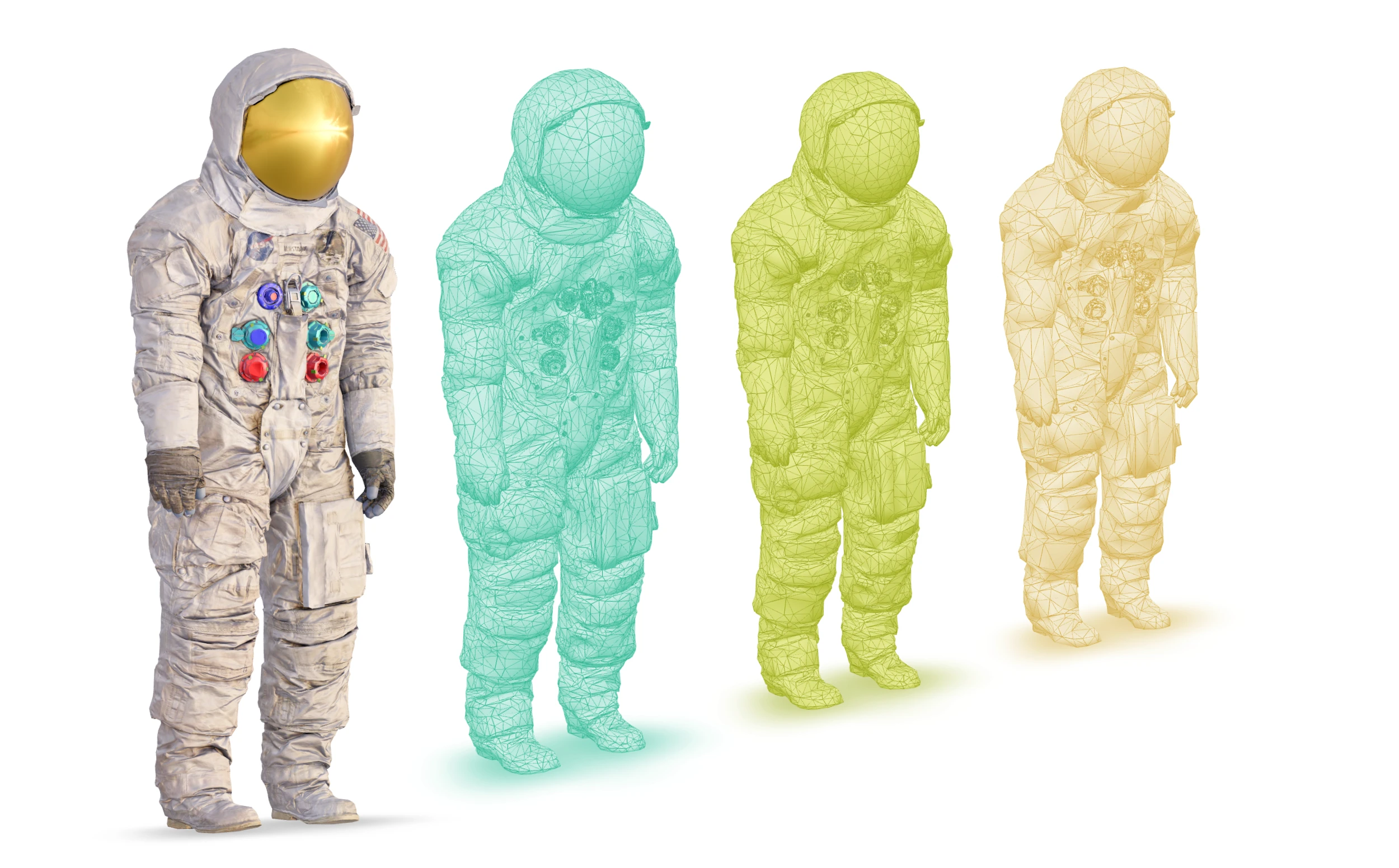
Every 3D web project hits the same wall: the model is too big. The file you get is a heavy FBX or USD with 4K textures; the page you ship needs to load in seconds on a phone. Between those two points sit format conversion, mesh compression, texture compression, LOD generation, and hosting — each with its own tools, flags, and failure modes.
Needle Cloud does that whole chain in one step: upload a file, get back an optimized glTF on a CDN.
What one upload gets you
- A web-ready glTF/GLB. Upload FBX, USD, OBJ, VRM, or glTF — conversion happens automatically, so everything downstream (three.js,
<model-viewer>, Needle Engine) speaks one standard format. - State-of-the-art compression. Meshes are compressed with Draco (static) and Meshopt (animated), textures with KTX2/Basis Universal or WebP — GPU-friendly formats that cut both download size and memory use.
- Automatic LODs for meshes and textures. The pipeline generates up to six levels of detail per asset. With
@needle-tools/gltf-progressive, your scene renders a light version immediately and streams in detail as needed — a 56 MB asset becomes a ~300 KB initial download. No remeshing, no exporting variants by hand. - A CDN URL you can use anywhere. Optimized assets are served from a global CDN. No CloudFront or Cloudflare setup — copy the URL and load it.
How it works
- Drag a file onto cloud.needle.tools — or upload straight from Unity, Blender, or the command line.
- The pipeline runs: conversion, compression, LOD generation.
- Use the result: load the URL with three.js, embed the built-in viewer, or share the link with your team or client. Versioning and access management are built in.
Works with plain three.js — no lock-in
You don’t need Needle Engine for any of this. The optimized files are standard glTF: load them with GLTFLoader like any other asset. If you want progressive LOD streaming, gltf-progressive is a small npm package that works with vanilla three.js and <model-viewer> — see our guide to embedding optimized models.
And if your scene uses image-based lighting, the same pipeline compresses EXR and HDRi files to FastHDR — up to 10× faster to load than EXR with around 95% less GPU memory.
The pipeline doesn’t stand still, either. As rendering on the web moves forward — new compression formats, smarter LOD strategies, techniques like FastHDR — we ship those improvements on our side, and your assets benefit the next time they’re optimized. You focus on building and on your content; keeping the pipeline current is our job.
Try it on your heaviest model
The free tier includes 30 optimizations — enough to find out what the pipeline does to your worst file. Your uploads stay private to you and your team.