
In the competitive world of virtual sports betting, content is king. Betting providers need a constant stream of events, but the traditional method of streaming pre-rendered video is costly and places a heavy bandwidth burden on both the provider and the end-user.
The team at Virtually Sports saw a path to a better solution: creating lightweight, interactive virtual sports that run directly in the browser. This approach would solve the bandwidth problem, reduce infrastructure costs, and offer a more engaging experience. The challenge was finding a tool that could deliver on this vision without forcing their team to abandon their existing Unity expertise.
We spoke with Stephen Long, CTO of Virtually Sports, to learn how they are using Needle Engine to solve this core industry problem.
The Challenge: Moving From Video Streams to Real-Time Web Apps
“The main thing is that it solves a problem… a bandwidth problem in this industry,” Stephen explains. The goal for Virtually Sports was to create products that were “the absolute complete opposite of what is traditionally done.” They wanted to build applications that were browser-based, client-run, and extremely lightweight.
To do this, they needed a platform that could:
- Export complex 3D scenes from Unity to the web with high performance and small file sizes.
- Integrate directly into their existing development pipeline.
- Offer reliable support and the right features to build commercial-grade products.
Why Needle Was the Right Fit
“We realized the product that we wanted to make, and then we started looking for the tools that would allow us to do that,” Stephen says. After evaluating alternatives, “Needle Engine is the one that really stood out.”
1. A Familiar Workflow with a New Target The biggest draw was Needle’s deep integration with Unity. “The fact that we could use it with Unity was really big,” Stephen notes. “A lot of our team had previous experience with Unity, so not having to learn an entirely new editor was just fantastic.”
This meant the team could continue working in a familiar environment. “Our workflow has probably largely remained the same… It allowed us to keep working the way we had traditionally worked. It’s the click of a button from the scene to get to that point. So it’s fantastic in that regard.”
2. Practical Features for Real-World Performance To keep their games fast and accessible, Virtually Sports utilizes several of Needle’s core optimization features. Stephen highlighted a few that have been particularly helpful:
- Automatic LOD Generation: “The auto-LOD feature that’s built-in has been fantastic for us.” Needle automatically creates lower-detail versions of models and textures, which is essential for maintaining performance.
- Progressive Texture Streaming: This ensures a fast initial load by loading textures as they are needed, rather than all at once.
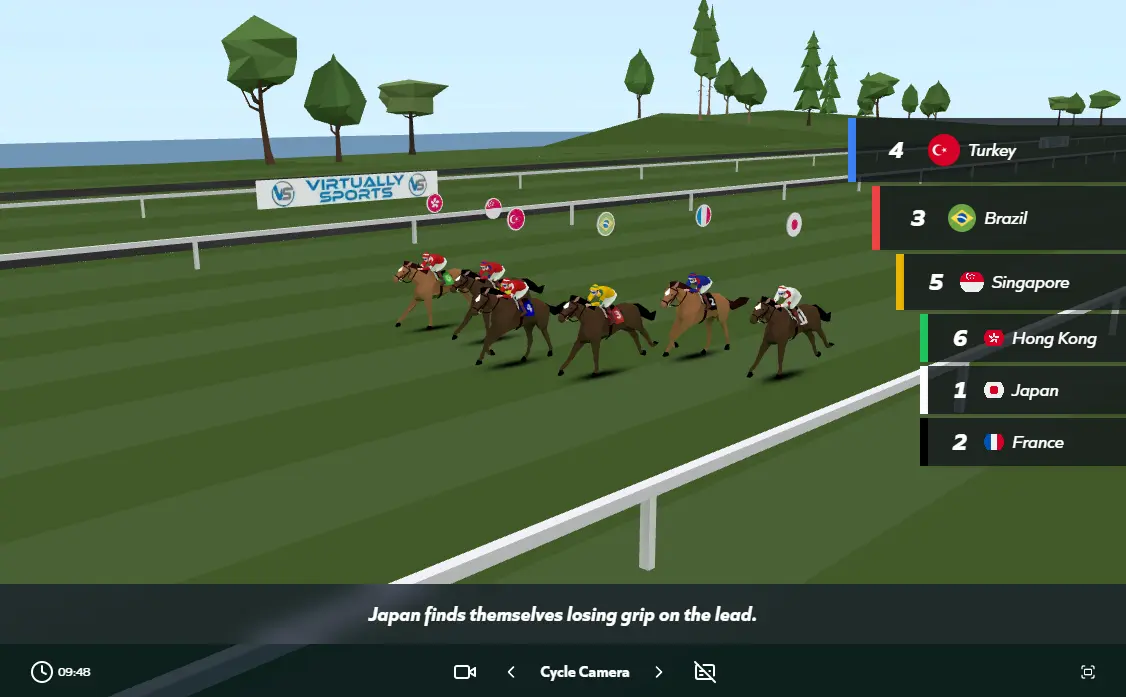
- Efficient Animation Handling: Even for their horse racing product, which features over 120 separate animations, the experience “still runs really smooth” in the browser.
3. Responsive and Helpful Support For any team adopting a new technology, good support is critical. Stephen praised the responsiveness of the Needle team. “Even in the early days, we could see that the support was really, really good,” he says. “We’ve requested features in the past, and some of the team have gotten that out so quickly.”
He also notes that the team’s help goes beyond simple bug fixes, recalling a time they helped his team simplify a complex asset-handling process. “They handle so much of this automatically.”
The Result: A New Breed of Virtual Sports
By using Needle Engine, Virtually Sports has successfully created a new category of virtual sports products. They have effectively solved the bandwidth issue that plagues the industry, allowing them to deliver a full suite of engaging, lightweight games—from beach soccer and football penalties to horse and camel racing—directly to users in the browser.
The client feedback has been very positive. For Virtually Sports, Needle has proven to be the right tool to connect their Unity expertise with the broad accessibility of the web, allowing them to innovate and build for the future.
Learn more about building for the web with Unity and Needle: